







ASVAB Exam Prep
Study Smarter. Pass Faster. Stay Sane.
2,000+ practice questions, detailed explanations, personalized quizzes, and progress tracking. Study on web, iPhone, or Android.


No Credit Card Required

Plans & Pricing
Access on Web, iPhone, & Tablets
 Best Value
Starting at
$9.99
Flexible options to fit your goals and study needs
-
Unlimited practice questions
-
Detailed explanations
-
Progress tracking & analytics
-
Access on Web, iOS, & Android
-
Personalized quizzes
-
Cancel anytime
What's on the exam?
-
Arithmetic Reasoning (AR)
-
Mathematics Knowledge (MK)
-
Word Knowledge (WK)
-
Paragraph Comprehension (PC)
-
General Science (GS)
-
Electronics Information (EI)
-
Auto and Shop Information (AS)
-
Mechanical Comprehension (MC)
-
Assembling Objects (AO)
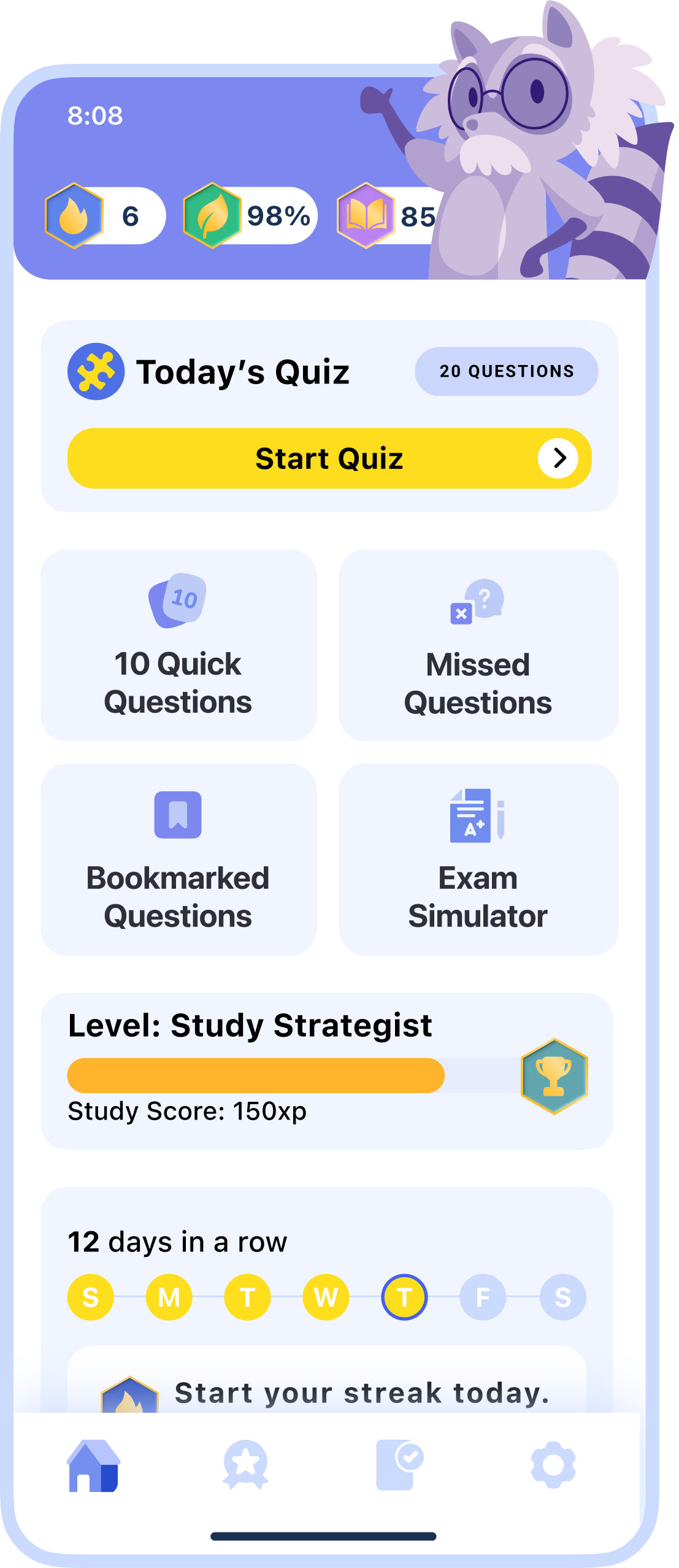
1,200+ real exam questions
Stay sharp with up-to-date content and clear explanations.
Daily goals & reminders
Stay motivated with personalized study targets.
Timed practice exams
Simulate the real test experience under pressure.
Sync across all devices
Study anytime, anywhere seamlessly.
Progress tracking
Spot your strengths and areas that need work.
Study by topic or difficulty
Focus on exactly what you need to improve.
What other test takes have to say
-
veroamalia, 12/19/2025
“Passed my AFQT! I really like how this app gamified the studying process. The little badges to earn were fun.” -
ckleeh, 09/03/2025
“This app had more and different questions on it, which challenged me. I passed my exam on July 26th by seven points. I highly recommend this app.” -
bri sa, 07/15/2025
“I also appreciated the ‘learn’ mode with concise explanations of the correct answer. It gave me a place to explore/review when I didn’t understand other options or terms.”
Frequently
Asked
Questions
-
The ASVAB (Armed Services Vocational Aptitude Battery) is the military’s entrance and job-placement test. Your results are used to (1) determine whether you qualify to enlist and (2) help match you to military career fields based on your strengths across different subject areas. ASVAB+1
-
The AFQT (Armed Forces Qualification Test) is not a separate exam. It’s a score computed from four ASVAB subtests and is used to determine basic enlistment eligibility (Army, Navy, Air Force, Marine Corps). ASVAB+2ASVAB+2
-
No. There’s only one test (the ASVAB). The ASVAB includes 10 subtests, and the AFQT is the enlistment-eligibility score calculated from WK, PC, AR, and MK.
-
The ASVAB covers 10 areas: General Science (GS), Arithmetic Reasoning (AR), Word Knowledge (WK), Paragraph Comprehension (PC), Math Knowledge (MK), Electronics Information (EI), Auto Information (AI), Shop Information (SI), Mechanical Comprehension (MC), and Assembling Objects (AO). (Some versions combine AI+SI into a single Auto/Shop score.) ASVAB+2ASVAB+2
-
AFQT is calculated from AR + MK + Verbal Expression (VE), where VE is derived from WK + PC (and then weighted). A common way it’s described is: AFQT = 2×VE + AR + MK. ASVAB+2Kaplan Test Prep+2
-
Your AFQT score is reported as a percentile from 1–99. For example, an AFQT of 62 means you scored as well as or better than 62% of a nationally representative reference group (commonly described as ages 18–23 from the norming study).
-
-
AFQT percentiles are grouped into categories (often used in eligibility reporting):
-
I: 93–99
-
II: 65–92
-
IIIA: 50–64
-
IIIB: 31–49
-
IVA: 21–30
-
IVB: 16–20
-
IVC: 10–15
-
V: 1–9 ASVAB+1
-
-
It depends on the branch and your education credentials, and requirements can change. Examples from official service sources: Army typically requires 31+ goarmy.com, the Air Force lists 31+ for high school grads (and higher for GED holders) Air Force, the Marines list 31+ (and higher for GED/nontraditional credentials) Marines, and the Coast Guard lists a minimum AFQT of 32 Go Coast Guard. The official ASVAB program also notes minimum qualifying scores vary across branches and points you to service-specific sites/recruiters.
-
You may take it on computer (CAT-ASVAB) or paper-and-pencil (often at MET sites). The official fact sheet shows different question counts/time limits by format, and notes the CAT-ASVAB is typically shorter for many test-takers.
-
Yes, but there are mandatory waiting periods: after your initial test, you must wait one calendar month to retake; another one month for a second retest; after that, six months between additional retests. The official FAQ also notes scores may be usable for enlistment for up to two years from the test date.
-
-
Start with a simple plan: diagnose → focus → simulate → review.
-
Take a baseline practice test first. This tells you exactly where you’re losing points and what to prioritize next. (The National Guard has a short practice test that works well as a quick starting point.) National Guard
-
Prioritize AFQT sections if enlistment is the goal. Your AFQT eligibility is driven by the “core” academic areas, so most score gains come from improving math + verbal fundamentals before you worry about the technical subtests. ASVAB
-
Study by subtest, not by vibes. Rotate targeted practice (weak areas) with mixed sets (realistic). The official ASVAB program recommends preparing in advance, knowing what to expect, and using sample questions to refresh the content areas you need most. ASVAB
-
Do timed sets and full-length simulations. Speed and stamina matter. Add timed quizzes early so timing doesn’t become the surprise boss fight on test day. ASVAB
-
Review missed questions like it’s your job. Don’t just re-do questions. Identify why you missed them (concept gap vs. careless error vs. time pressure) and fix that root cause with a short drill set. ASVAB
-
Use our app for structured daily reps. In our ASVAB prep app, you can do focused practice by category, run timed simulations, track weak areas, and keep momentum with streaks/badges so you actually stick with the plan.
If you want, tell me the user’s target branch (or target AFQT) and time until test day, and I’ll turn this into a 2–4 week study schedule you can reuse as a template.
-


