

3 Nov 2026
Updated: 3 Nov 2026
ASWB Exam 2027: What’s New, What to Expect, and How to Prepare
Planning to take the ASWB exam in 2027? Whether you’re preparing for the ASWB Masters, Clinical, Bachelors, or Advanced Generalist exam, knowing what to expect is one of the most important steps toward effective preparation.
And if you’ve already started studying with older textbooks, practice questions, or study guides, there’s something you should know.
The Association of Social Work Boards (ASWB) introduced major examination changes on August 3, 2026. These updates reduced the number of questions, reorganized the content areas, and placed greater emphasis on applying professional knowledge to real-world situations.
So, what should you expect from the ASWB exam in 2027?
Based on the current official ASWB examination blueprint, here’s what you need to know:
- 122 total questions: 110 scored questions and 12 unscored pretest questions.
- Three content areas: Values and Ethics, Assessment and Planning, and Intervention and Practice.
- Four hours of examination time: Divided into two timed sections.
- Updated question structure: A mixture of three- and four-option multiple-choice questions.
- Greater emphasis on professional reasoning: Questions assess your ability to apply social work knowledge, not simply memorize facts.
As of November 3, 2026, ASWB’s official guidance continues to identify the August 2026 examination blueprint as the current format. No separate 2027 examination redesign has been announced in the official materials reviewed.
The good news? You don’t need to start your preparation from scratch. You need a clear strategy that reflects the examination you’re preparing to take.
In this guide, we’ll explain the current ASWB exam format, explore the subjects you should prioritize, and share practical study strategies to help you prepare for your 2027 licensing exam.
What Is the ASWB Exam Format for 2027?
The ASWB exam measures whether social work candidates demonstrate the knowledge and competencies required for safe and ethical entry-level practice at their examination category.
The current exam format was introduced on August 3, 2026, following ASWB’s examination development and practice analysis process.
Here’s how the updated exam compares with the previous format.
| Exam feature | Previous ASWB exam | Current exam format |
|---|---|---|
| Total questions | 170 | 122 |
| Scored questions | 150 | 110 |
| Unscored questions | 20 | 12 |
| Content areas | 4 | 3 |
| Exam duration | 4 hours | 4 hours |
| Multiple-choice options | Mostly 4 options | Mix of 3 and 4 options, with more 3-option questions |
| Content emphasis | Knowledge and application | Greater emphasis on applied knowledge and reasoning |
Source: ASWB’s official examination update.
Does Having Fewer Questions Make the ASWB Exam Easier?
Not necessarily.
Although the updated ASWB exam has fewer questions, it still evaluates the professional knowledge and judgment required for social work practice.
ASWB redesigned the examination to emphasize applied knowledge, problem-solving, and professional reasoning.
This means you may need to interpret a client situation, recognize an ethical concern, identify an assessment priority, or choose the most appropriate intervention.
Simply memorizing definitions may not be enough.
The takeaway: Your preparation should focus on understanding concepts and recognizing how to apply them to different situations.
Which ASWB Exam Will You Take in 2027?
Before creating your study schedule, make sure you know which ASWB examination category your licensing board has approved you to take.
ASWB offers four primary examination categories.
ASWB Bachelors Exam
Designed for candidates pursuing licensure at the bachelor’s level, this examination measures foundational generalist social work knowledge and skills.
ASWB Masters Exam
The Masters exam evaluates the knowledge and competencies associated with master’s-level social work practice.
It is commonly associated with certain LMSW licensing pathways, although license titles and requirements vary by state.
ASWB Advanced Generalist Exam
This examination focuses on advanced generalist practice, including work with individuals, groups, organizations, communities, and larger systems.
It is intended for advanced practitioners who meet applicable education and experience requirements.
ASWB Clinical Exam
The Clinical exam evaluates advanced clinical social work knowledge and its application to assessment, diagnosis, intervention, and professional practice.
Candidates generally need a qualifying graduate degree and supervised clinical experience, subject to their licensing jurisdiction’s requirements.
Important: Your state licensing board determines your eligibility and which examination category applies to your license. Don’t choose an exam based only on a license abbreviation.
For more information, visit our guide to ASWB examination levels and requirements.
What Topics Are Covered on the ASWB Exam in 2027?
The current ASWB examination blueprint organizes its content into three main areas:
- Values and Ethics
- Assessment and Planning
- Intervention and Practice
Each area measures specific competencies and applied knowledge statements relevant to professional social work practice.
The exact subjects and expectations depend on your examination category.
1. Values and Ethics
Values and Ethics is the highest-weighted content area across all four ASWB examination categories.
Depending on your exam category, it accounts for approximately 35% to 36% of scored examination content.
This area focuses on the professional principles and ethical responsibilities that guide social work practice.
Relevant topics may include:
- Client confidentiality and privacy
- Informed consent
- Professional boundaries
- Client self-determination
- Cultural responsiveness and diversity
- Professional competence
- Ethical decision-making
- Social justice and advocacy
- Ethical responsibilities in service delivery
Study tip: Don’t simply memorize ethical principles. Practice recognizing how those principles apply to client situations.
For example, if a client requests something that may create a conflict with professional responsibilities, you need to understand both the client’s rights and the applicable ethical standards.
The exam may ask you to identify the most appropriate professional response.
2. Assessment and Planning
Assessment and Planning represents approximately 32% to 33% of the scored examination content, depending on your category.
This section focuses on understanding client needs, identifying concerns, assessing relevant circumstances, and developing appropriate plans.
Topics may include:
- Human behavior and development
- Biopsychosocial assessment
- Client strengths and support systems
- Risk and safety assessment
- Assessment techniques
- Identifying client needs and priorities
- Collaborative treatment or service planning
- Interpreting assessment findings
Study tip: Practice identifying what information a social worker needs before deciding on an intervention.
For example, imagine a client reports increasing stress, difficulty sleeping, and problems managing daily responsibilities.
A social worker may need to explore the client’s functioning, stressors, supports, and potential safety concerns before recommending a particular service.
Understanding the assessment process helps you recognize when additional information is needed.
3. Intervention and Practice
Intervention and Practice represents approximately 32% of the scored examination content across exam categories.
This section evaluates how social workers apply professional knowledge when working with clients and client systems.
Relevant subjects may include:
- Evidence-informed interventions
- Crisis intervention
- Client engagement and communication
- Service coordination
- Referrals and community resources
- Client advocacy
- Evaluating intervention effectiveness
- Professional consultation and supervision
- Practice evaluation and research
The exact scope varies depending on whether you’re preparing for the Bachelors, Masters, Advanced Generalist, or Clinical exam.
For example, Clinical candidates may need to demonstrate more advanced knowledge of clinical interventions, while Bachelors candidates focus on foundational generalist competencies.
The most reliable preparation resource is the official ASWB Examination Guidebook, which includes the content outlines for each examination category.
ASWB Exam 2027 Content Breakdown by Exam Level
Although all examination categories use the same three content-area names, their weightings differ slightly.
| Content area | Bachelors | Masters | Advanced Generalist | Clinical |
|---|---|---|---|---|
| Values and Ethics | 35% | 35% | 35% | 36% |
| Assessment and Planning | 33% | 33% | 33% | 32% |
| Intervention and Practice | 32% | 32% | 32% | 32% |
| Total | 100% | 100% | 100% | 100% |
Source: ASWB’s 2024 Analysis of the Practice of Social Work and 2026 Examination Blueprints.
How Should You Use These Percentages?
The percentages can help you organize your study priorities.
Values and Ethics deserves consistent attention because it represents the largest individual content area.
However, the other two areas together account for most of the exam.
Instead of studying only your strongest subject, consider dividing your preparation into three categories and tracking your understanding of each one.
For example, if you’re comfortable with ethics but frequently miss questions related to assessment, give assessment additional study time.
A balanced study routine is more useful than focusing entirely on one content area.
How Are ASWB Exam Questions Different Now?
The updated examination places greater emphasis on applying professional knowledge.
This means you’ll need to understand the reasoning behind a decision, not simply recognize the correct terminology.
You may encounter questions that ask:
- What should the social worker do FIRST?
- What is the BEST response to the client’s situation?
- Which intervention is MOST appropriate?
- What should the social worker do NEXT?
These questions can feel challenging because more than one answer may describe a reasonable action.
Your job is to identify the answer that best addresses the specific circumstances.
Example: An ASWB-Style Practice Question
Let’s look at an original educational example.
A social worker meets with a client who reports increasing stress and difficulty managing responsibilities at work and home. The client asks for assistance but has not discussed specific goals or immediate needs. What should the social worker do FIRST?
A. Recommend a particular intervention immediately.
B. Conduct an initial assessment of the client’s concerns, functioning, strengths, safety, and priorities.
C. Refer the client to a community support group without gathering additional information.
Correct Answer: B
Explanation:
Before recommending an intervention or referral, the social worker should gather sufficient information to understand the client’s situation.
An initial assessment can help identify concerns, available resources, strengths, goals, and any safety issues that may require attention.
Options A and C involve taking action before obtaining enough information to determine what the client needs.
What this teaches: When answering ASWB scenario questions, identify the stage of the social work process and determine which action is most appropriate based on the information provided.
This is an original educational example, not an actual ASWB examination question.
How to Approach Scenario-Based Questions
Try this four-step approach:
Step 1: Identify the main issue. What is happening in the situation?
Step 2: Read the question carefully. Is it asking for the FIRST, NEXT, BEST, or MOST appropriate action?
Step 3: Compare the answer choices. Which response best addresses the issue and follows relevant professional principles?
Step 4: Check your reasoning. Does your chosen answer respond to the information in the question, or are you making assumptions?
This method can help you approach unfamiliar situations more systematically.
How Many Questions Are on the ASWB Exam in 2027?
Under the current blueprint, the ASWB examination contains 122 multiple-choice questions.
Of those, 110 questions contribute to your score, while 12 are unscored pretest questions.
The unscored questions help ASWB evaluate items for possible use on future examinations.
You won’t know which questions are scored and which are unscored, so treat every question as important.
How Much Time Do You Have?
The examination is divided into two sections.
| Examination section | Questions | Time limit |
|---|---|---|
| Section 1 | 61 | 2 hours |
| Optional scheduled break | — | Up to 10 minutes |
| Section 2 | 61 | 2 hours |
During each section, you can skip questions, flag them for review, and change your answers.
However, once you submit the section, you cannot return to it.
The optional scheduled break occurs between sections, and the exam clock stops for up to 10 minutes. Unscheduled breaks are also possible under ASWB testing procedures, but the clock continues running.
ASWB Time Management Tips
With two hours for each 61-question section, you have an average of approximately two minutes per question.
Use your practice sessions to develop a comfortable pace.
A few strategies worth trying:
- Read each question carefully before selecting an answer.
- Watch for important qualifiers such as FIRST, NEXT, BEST, and MOST.
- Eliminate answers that don’t address the situation.
- Flag difficult questions when necessary.
- Review unanswered questions before submitting a section.
- Avoid spending too much time repeatedly reconsidering the same answer.
You don’t need to rush through every question. The goal is to manage your time without sacrificing careful reasoning.
Can You Still Use Older ASWB Study Materials in 2027?
Yes. Some older ASWB study materials may still be useful, but they should be reviewed against the current examination blueprint.
This is especially important if you purchased a textbook or practice course before August 2026.
Foundational social work concepts remain relevant, but older examination descriptions may no longer be accurate.
Here’s a practical way to evaluate your study materials.
| Study resource | Recommendation |
|---|---|
| Foundational social work textbooks | Keep and review for relevance |
| Older ethics notes | Keep, but supplement with current guidance |
| Four-domain ASWB study outlines | Reorganize using the three current content areas |
| Old 170-question practice exams | Replace for accurate exam-format simulations |
| Old passing-score charts | Update using current ASWB scoring guidance |
| Scenario-based practice questions | Review individually for continued relevance |
| Official ASWB Examination Guidebook | Use as your primary examination reference |
The 5-Point ASWB Study-Material Check
Before relying on a resource, ask:
1. Does it describe 122 total questions?
If it still says 170, its examination-format information is outdated.
2. Does it use the three current content areas?
Look for Values and Ethics, Assessment and Planning, and Intervention and Practice.
3. Does it match your examination category?
A Clinical candidate should not assume that a general Bachelors practice guide covers all the required clinical competencies.
4. Does it explain why answers are correct?
Understanding the reasoning is more useful than memorizing answer letters.
5. Does it help you identify weaknesses?
A practice resource should help you recognize the subjects you need to review.
If a resource doesn’t meet all five criteria, it may still contain useful foundational material, but it should not be your only preparation source.
How to Study for the ASWB Exam in 2027: A 6-Week Plan
Not sure how to organize your preparation?
A structured study plan can help you balance the three content areas, improve your reasoning skills, and identify areas that need additional attention.
Here’s a flexible six-week study plan.
| Week | Study focus | Recommended activities |
|---|---|---|
| Week 1 | Understand the exam | Review the official blueprint, organize materials, complete a baseline practice quiz |
| Week 2 | Values and Ethics | Review professional responsibilities, confidentiality, and ethical decision-making |
| Week 3 | Assessment and Planning | Focus on assessment techniques, client needs, safety, and planning |
| Week 4 | Intervention and Practice | Study intervention strategies, service coordination, and practice evaluation |
| Week 5 | Applied reasoning | Practice mixed scenario-based questions and timed sections |
| Week 6 | Final preparation | Review weak areas, analyze practice results, rehearse exam timing, and prepare for test day |
This is a suggested study schedule, not an ASWB-approved preparation plan.
You may need more or less time depending on your educational background, professional experience, available study hours, and practice performance.
Week 1: Build Your Foundation
Start by reviewing the official ASWB content outline for your examination category.
Then complete a mixed practice quiz to identify your current strengths and weaknesses.
Don’t worry about achieving a perfect score during your first session.
The goal is to understand where you are starting.
Weeks 2–4: Study Each Content Area
Dedicate focused time to each major content area.
Instead of reading large amounts of material without reviewing, alternate between concept study and practice questions.
For example:
- Review a topic.
- Answer related practice questions.
- Read the explanations.
- Record mistakes.
- Revisit the topic after a few days.
This makes your study sessions more purposeful.
Week 5: Strengthen Your Professional Reasoning
By this stage, start practicing questions from different content areas in the same session.
Focus on understanding the situations presented and identifying the most appropriate professional response.
Include timed practice to become familiar with the examination’s pacing.
Week 6: Review and Refine
Use your final study sessions to review topics you continue to find difficult.
Avoid spending all your remaining time repeating questions you’ve already memorized.
Instead, review incorrect answers, revisit key concepts, and practice applying your knowledge to unfamiliar scenarios.
For additional study strategies, read our No-Nonsense Guide to Effective Studying for the ASWB Exam.
How to Know If You’re Making Progress
One of the most useful ways to prepare for the ASWB exam is to track what you’re learning.
After each practice session, record:
- The number of questions answered
- Your percentage of correct answers
- The topics you missed
- The reasons for your mistakes
- The concepts you need to revisit
For example, imagine you complete a 30-question quiz and answer 22 questions correctly.
Rather than focusing only on the percentage, review the eight incorrect answers.
Were most of your mistakes related to confidentiality? Did you misunderstand assessment priorities? Did you overlook the word FIRST in a question?
Understanding the reason behind your mistakes makes it easier to plan your next study session.
Don’t Rely on One Practice-Test Score
A high practice-test score can be encouraging, but it doesn’t guarantee you’ll pass the actual ASWB exam.
Practice questions vary in difficulty and may not reflect the exact content distribution of your examination.
Look for consistent improvement across different question sets, stronger understanding of answer explanations, and better performance on previously difficult topics.
You can use EZ Test Prep’s ASWB practice questions, personalized quizzes, and progress-tracking tools to organize your review sessions and monitor your progress.
What Is the ASWB Passing Score in 2027?
The ASWB examination is pass/fail, and the required number of correct answers varies by examination form.
Under the current 110-scored-question format, ASWB states that passing scores generally range from 66 to 78 correct answers.
However, there isn’t one guaranteed passing percentage for every candidate.
The passing threshold depends on the difficulty of the examination form administered.
This means you should not assume that a particular percentage on an unofficial practice quiz guarantees a passing result.
Instead, focus on understanding the content, strengthening your weaker areas, and becoming comfortable with professional reasoning questions.
For the most accurate information, consult ASWB’s official exam scoring guidance.
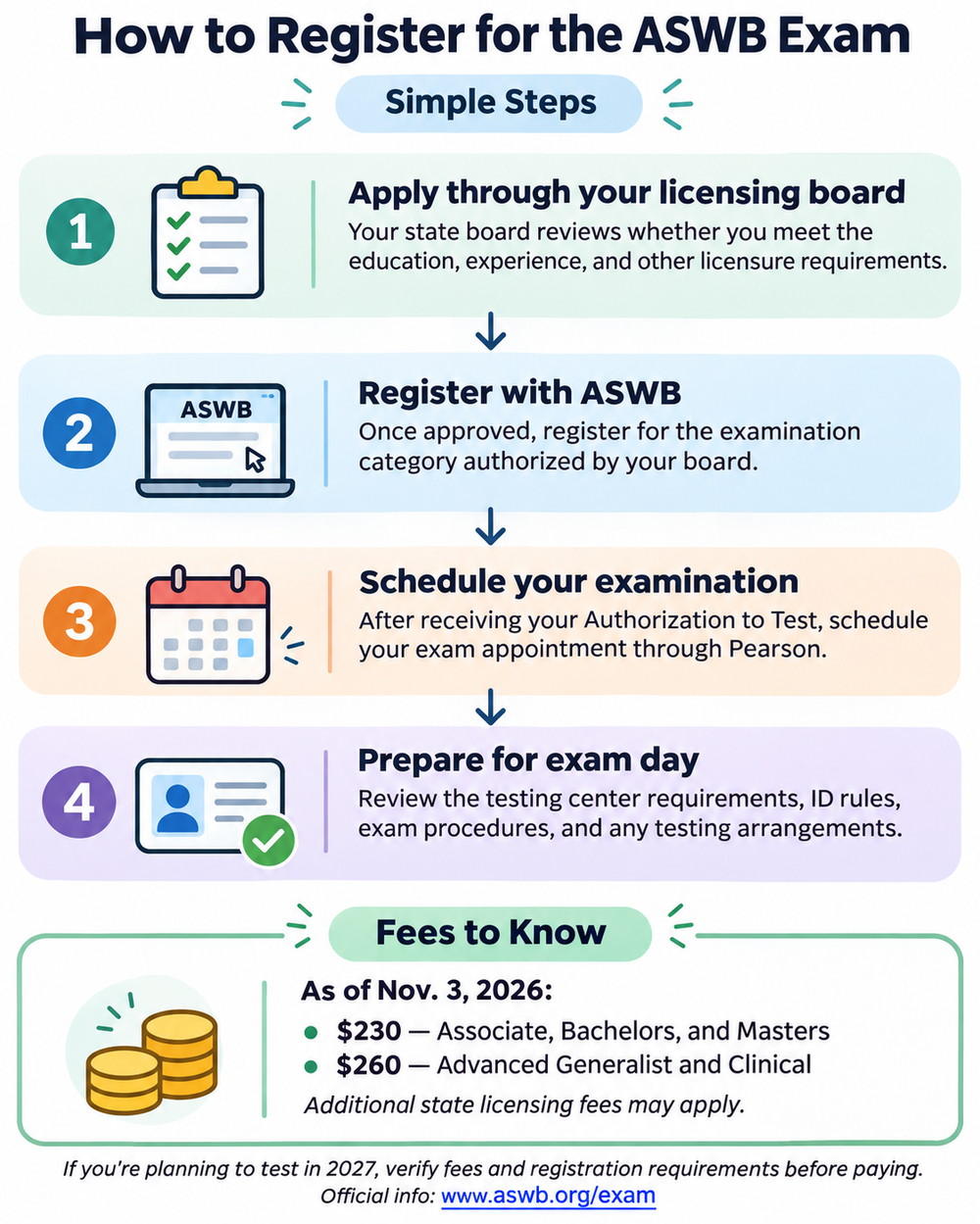
How Do You Register for the ASWB Exam?
Before registering, you’ll generally need approval from your social work licensing board.
The usual registration process follows these steps:
Step 1: Apply through your licensing board.
Your state board determines whether you meet the applicable educational, experience, and other licensure requirements.
Step 2: Register with ASWB.
Once approved, you can register for the examination category authorized by your board.
Step 3: Schedule your examination.
After receiving your Authorization to Test information, schedule your appointment through Pearson.
Step 4: Prepare for exam day.
Review the testing center’s requirements, identification rules, examination procedures, and any applicable testing arrangements.
As of November 3, 2026, ASWB lists registration fees of $230 for Associate, Bachelors, and Masters examinations and $260 for Advanced Generalist and Clinical examinations. Additional state licensing fees may apply.
Because you’re preparing for an examination in 2027, verify fees and registration requirements again before paying.
Visit the official ASWB examination information page for current details.
Common ASWB Exam Preparation Mistakes to Avoid in 2027
Even a well-organized study plan can become less effective if you’re making these common mistakes.
1. Using Outdated Exam Information
Make sure you’re studying the current examination format.
If your guide still describes four content areas and 170 questions, verify its information against ASWB’s updated blueprint.
2. Memorizing Answers Instead of Concepts
Remembering the correct answer to a familiar question doesn’t necessarily mean you can solve a new question testing the same principle.
Review explanations and learn the reasoning behind each answer.
3. Studying Only Your Strongest Subjects
It’s natural to prefer topics you understand well.
However, the ASWB exam covers all three content areas.
Use your practice results to identify which areas need more attention.
4. Ignoring Timed Practice
Understanding the material matters, but so does answering questions within the time allowed.
Practice completing longer question sets and managing your time across each section.
5. Trying to Learn Everything at the Last Minute
Last-minute cramming can leave little time to identify and address knowledge gaps.
Start early enough to review the content, practice applying concepts, and revisit difficult topics.
For more ways to strengthen your preparation, explore our ASWB study tips and tricks.
Frequently Asked Questions About the ASWB Exam in 2027
Is the ASWB exam changing again in 2027?
As of November 3, 2026, the official ASWB materials reviewed identify the blueprint introduced on August 3, 2026, as the current examination format. A separate redesign for 2027 has not been announced in those materials. Candidates should continue checking ASWB for updates before their exam dates.
How many questions are on the ASWB exam in 2027?
Under the current format, the ASWB exam includes 122 multiple-choice questions, of which 110 are scored and 12 are unscored pretest questions.
What are the three ASWB content areas?
The three content areas are Values and Ethics, Assessment and Planning, and Intervention and Practice. The exact content and weightings vary by examination category.
Is the ASWB Clinical exam harder than the Masters exam?
The Clinical and Masters exams evaluate different levels and types of professional competence. The Clinical exam assesses advanced clinical practice, while the Masters exam focuses on master’s-level social work competencies. It isn’t appropriate to assume one is universally harder because they serve different licensing pathways.
How long should I study for the ASWB exam?
There isn’t one ideal study period for every candidate. Your preparation timeline depends on your background, familiarity with the content, schedule, and practice performance. A six-week plan can provide structure, but some candidates may benefit from additional time.
Can I use older ASWB study guides in 2027?
Yes, older materials may still contain valuable foundational information. However, their exam specifications, content outlines, and scoring references should be checked against current ASWB guidance.
Can I take the ASWB exam online from home?
ASWB suspended its online-proctoring pilot effective July 31, 2026. Under the currently published examination process, candidates schedule exams at Pearson test centers. Check ASWB before your 2027 appointment in case testing options change.
What is the best way to prepare for the ASWB exam in 2027?
Start with the official content outline for your examination category. Study all three content areas, practice applying social work knowledge to realistic scenarios, review incorrect answers, and include timed question sets in your routine.
Final Thoughts: Make 2027 the Year You Prepare With Purpose
Preparing for your ASWB exam is an important step toward your social work licensing goals.
The examination may feel challenging, especially when you’re balancing work, personal responsibilities, and study time.
But effective preparation doesn’t have to mean spending every free moment buried in textbooks.
Start by understanding the current ASWB exam format, organizing your study materials, and focusing on the topics that need attention.
Practice applying professional knowledge. Review mistakes instead of simply moving on. And give yourself enough time to develop a consistent study routine.
Remember, the goal isn’t to memorize every practice question.
It’s to develop the knowledge and professional judgment needed to demonstrate your readiness for social work practice.
Ready to Start Preparing for Your ASWB Exam?
Studying for your social work licensing exam can feel overwhelming, but having the right tools and a clear routine can make the process more manageable.
EZ Test Prep offers ASWB preparation resources to help you organize your studying and focus on the areas you need to improve.
With practice questions, detailed answer explanations, personalized quizzes, and progress tracking, you can build a more structured study routine and monitor your progress along the way.
Whether you’re preparing for the ASWB Masters, Clinical, Bachelors, or Advanced Generalist examination, use the official ASWB blueprint alongside your study resources to guide your preparation.
Explore EZ Test Prep’s ASWB Exam Preparation Resources
Study smarter. Stay consistent. And keep moving toward your social work licensing goals.
Exam information reviewed November 3, 2026. This guide describes the current official ASWB examination format as candidates prepare for 2027. Requirements and examination policies may change. Always confirm the latest information with ASWB and your state licensing board.
EZ Test Prep is an independent examination-preparation provider and is not affiliated with, endorsed by, or sponsored by the Association of Social Work Boards (ASWB).
Apologies, there are currently no related posts available for this article.
